Strawberry Mansion
Strawberry Mansion is both an historic house in Fairmount Park in Philadelphia and the neighborhood of mostly row houses that sits to the east of the park and near the mansion. Diamond Street where we lived runs perpendicular to 33rd Street, which borders the park. In the park there is what looks like a low, broad hill. It is not a hill at all; it is a bank of earth set against the side of a reservoir. My father who was athletic and used to teach tennis and run track, ran around the pathway that circled the reservoir. Occasionally he would take me and my brother, but sometimes just me on a walk around the reservoir. I don’t remember the view of the reservoir itself, but I do remember the beckoning views of the cosmos that filled my brain when he tried to explain what a light year is and also the speed of light.
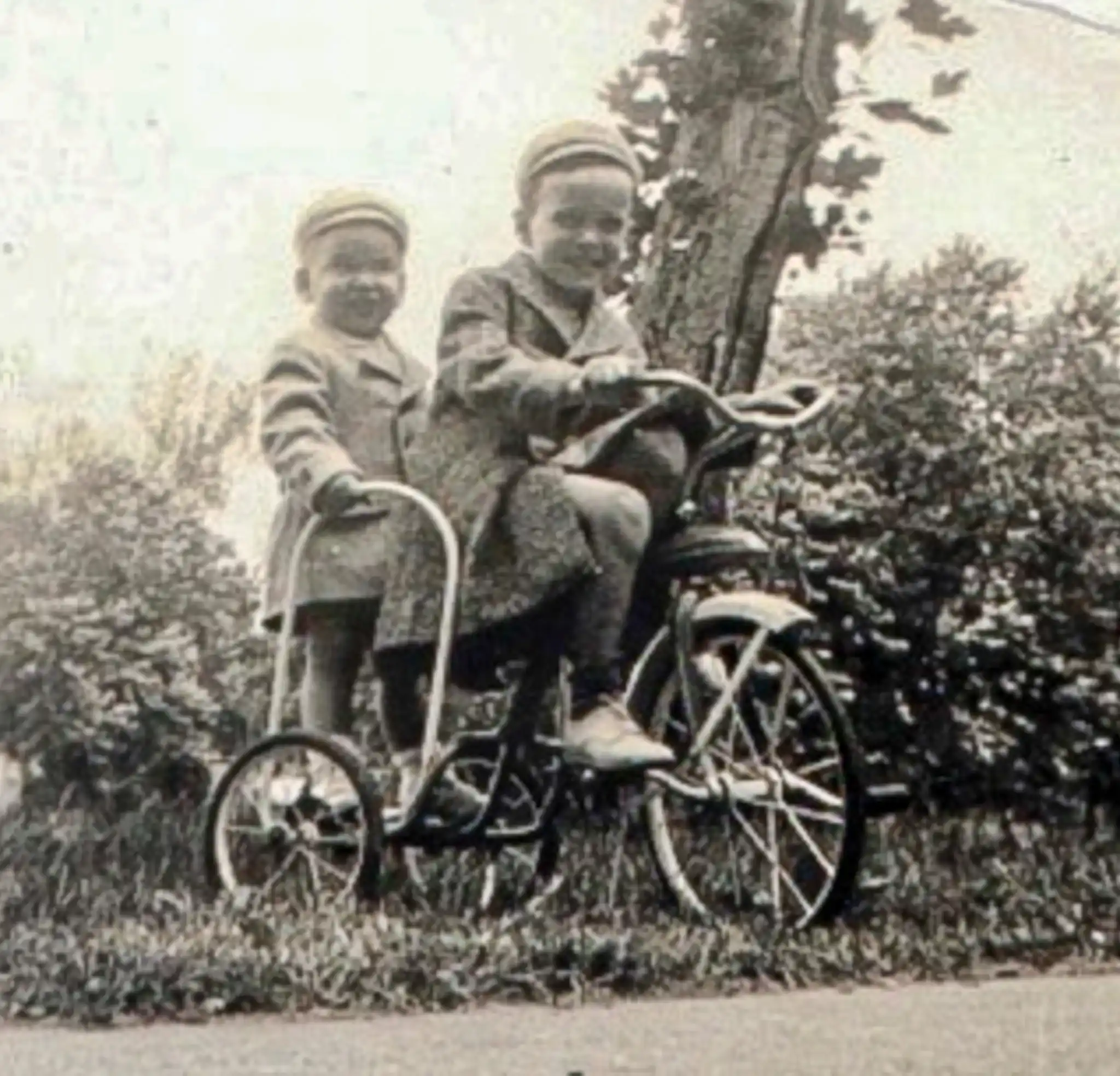
Our rowhouse still exists at 3118 West Diamond Street, one and a half blocks from Fairmount Park, one of the largest city parks in the United States. It was here in 1876 that the Centennial Exhibition was held, which brought people from around the world to see the latest innovations in science, art, education, industry, and the like. (more on the Centennial Exhibition later in this book)
Once in the park, Diamond Street becomes Diamond Drive. That leads to Reservoir Drive which circles around what looks to be, from the road, like just a large raised plateau. My father, slim and athletic in his youth, used to run around the path that circled the reservoir; it was a place for exercise that attracted the likes of Muhammed Ali. Awe-inspiring views of the Schuylkill River and center city Philadelphia spread out below from that elevated vantage.
I recall, almost as if it happened a year ago (it was more than seventy years ago) that my father on one particular stroll began speaking of ideas that were to my naïve ears totally other-worldly. He told me there was something called a light year and that something I couldn’t see that traveled at the speed of light. My little brain, already limited by eyes that were extremely compromised by myopia, struggled to comprehend these far-from-everyday ideas. My mind surely must have flashed back to that mysterious moment when I peered up into that night sky in the backyard. I tried to imagine things that belonged to a world far beyond my comprehension; my recollection today still reverberates with a black puzzling void. Perhaps it was because I was so totally near-sighted that my imagination had to compensate in ways that would later well serve my creative and theoretical pursuits.
On another occasion, while walking on Reservoir Drive, a jet roared overhead suddenly producing an explosive…boom. My father tried to explain the concept of breaking the sound barrier. These efforts at introducing me to concepts well beyond my ability to comprehend actually taught me little, but they did have the positive benefit of opening my mind to the beckoning puzzles of how the world works and the enormity and mysteries of the cosmos. It was not long thereafter that my maternal grandfather Papa introduced me to the philosophical and scientific writings of Sir Bertrand Russell and Sir James Jeans. Papa shared his belief in a universe without a god. The doors of philosophy were flung open for me and it was obvious from then on that I had to think for myself and question everything that I read.
An Introduction to the Cosmos
One of my earliest memories, perhaps my earliest memory as a toddler, was when my father swept me up off the floor of our living room and took me out the side door of our first-floor apartment. He carried me outside to the back garden to see something in the dark night sky. I believe this occurred long before it was discovered I needed glasses. Not only would his face not have been in sharp focus, but anything he might have been pointing to in the night sky was certainly not clearly visible to me if it had been a constellation of stars or the like. However, the total lunar eclipse of May 3rd, 1939 might have been the reason my father would have taken me outside. I was only five months old, but I sensed the event had importance even though my memory of the specifics is dim. My father liked to share the sight or sound of phenomena like that and tried to explain what he was pointing out. One day in 1945 he brought my brother and me into the house to hear over the radio (no TVs back then) the sound of the first atomic bomb. I would have been about six and half years old. I have a memory of running out of the house fearing the sound would explode our first-floor apartment.
An Aesthetic Sensibility
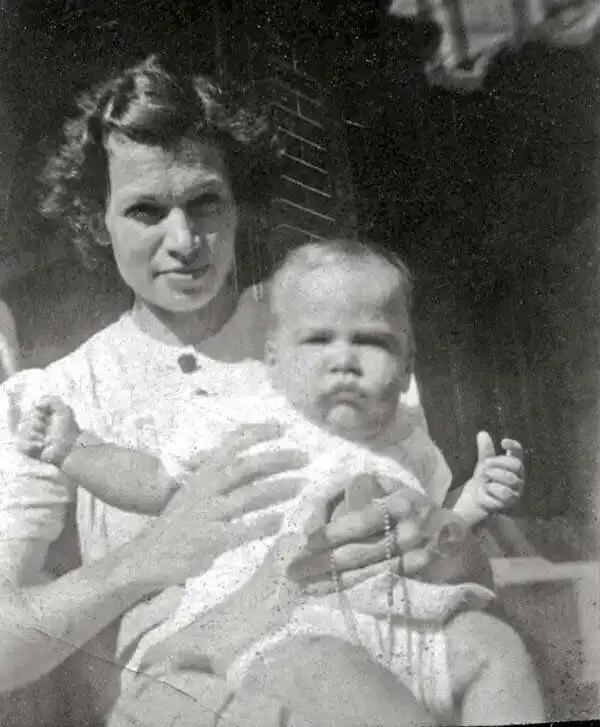
Another early memory is being held in my mother’s arms on a street corner in our neighborhood and seeing, close up, the face of a women on a blindingly bright sunny day. I had such a strong reaction to her face that I would be motivated to write about it these many years later. The face I saw belonged to an acquaintance of my mother. She had a dough-face covered with small, round, skin-colored, dome-shaped bumps about the size of a pea. My mother was holding me, an infant, or toddler, in her arms as she paused for a moment to speak. This event occurred years before it was discovered that I needed glasses and so it is natural that I would describe the face as though it looked like it was created by someone who made pizzas. Most of what I saw until the age of about six looked like it was rendered in a layer of dust unless the subject was no further away than the width of my little fist at which distance it had a welcoming degree of sharp focus. What I recall, the many times that I have turned this memory over in my mind, is that the experience was not really that of seeing a memorable face but in seeing what I deemed an ugly face and in being aware, at that very young age, that I could be repelled by what was ugly. This was long before I understood words or had any idea about abstract ideas such as beauty and ugliness. The visual world seems to be what I was created to react to; it was then and has remained ever since one of the most compelling forces shaping my life.
Meatballs
My father used the front room of our apartment on Diamond Street as his at-home law office. I believe he also had an office in Center City back then. A bronze plaque, rather conventional in design, was affixed to the façade of our three-story brownstone. The sign was readable from the stoop: Abraham J. Levinson (and in smaller print and in italics) Attorney at Law. It seemed to me special to have such a formal and serious marker on our house and although there were two other apartments above ours in what originally might have been a single-family residence.
My father had a desk and some leather guest chairs and a couch in his front-room office. It was spare and not particularly impressive with probably a framed image of men in capes and wigs; the kind of drawing lawyers typically had in their offices.
One day my brother and I were alone in the apartment with nothing much to do. This was before the age of televisions and we weren’t into reading books at that age. I was about six or seven and my brother was two years older. I suppose we wanted to have a catch but couldn’t find a ball to play with. I would like to take credit for finding the substitute for what we called a pinkie or for one of my father’s tennis balls, but I have no certain recollection. I was a kid not bound by convention or standard modes of thought and whether it was my idea or my brother’s to use ground beef matters not.
The fact is that we ended up with a bowl of raw hamburger beef and fashioned our own balls to toss around. How we ended up in my father’s office I couldn’t say, but there we played. One of us must have missed a throw and a ball of sticky red meat sailed out of reach and flattened on the tall blank wall behind my father’s desk. Oops!
I imagine that we just stared at the red puck of greasy sirloin stuck to the wall until it began to peel ever so slowly then drop to the floor with a plop. Hill and I thought that was really funny. And so the game began which was: who could get their ball of meat to stick on the wall the longest. We were roaring with laughter as we watched our meatballs splat against the light blue wall, stick there for an admirable few minutes then sag, peel, and finally drop to the floorboards leaving behind an array of almost perfectly round telltale stains of grease. After a half hour or so of wild fun, we tired of this inventive pastime and went on to other mischievous activity leaving the wall looking like the face of a young teenager covered with zits.
Was it possible that we knew that we were doing a bad thing at the time and went ahead anyway? Was it possible we had no idea our game was wrong-headed? Was it possible we thought the grease stains would disappear like evaporating water with barely a trace of residue? Was it possible we were just plain nuts? Was something missing in our upbringing that would allow us to compromise the place where our father earned the money to pay the rent, not to mention the food and clothes we used each day?
That night my father, his face red like the ground beef we had been tossing around his office, pulled down our pants, loosened his belt (in our house we called it a strap) from around his pear-shaped middle and whacked the living shit out of us. We bawled and bawled and finally realized that we had done a bad thing.
My First Sense of Race
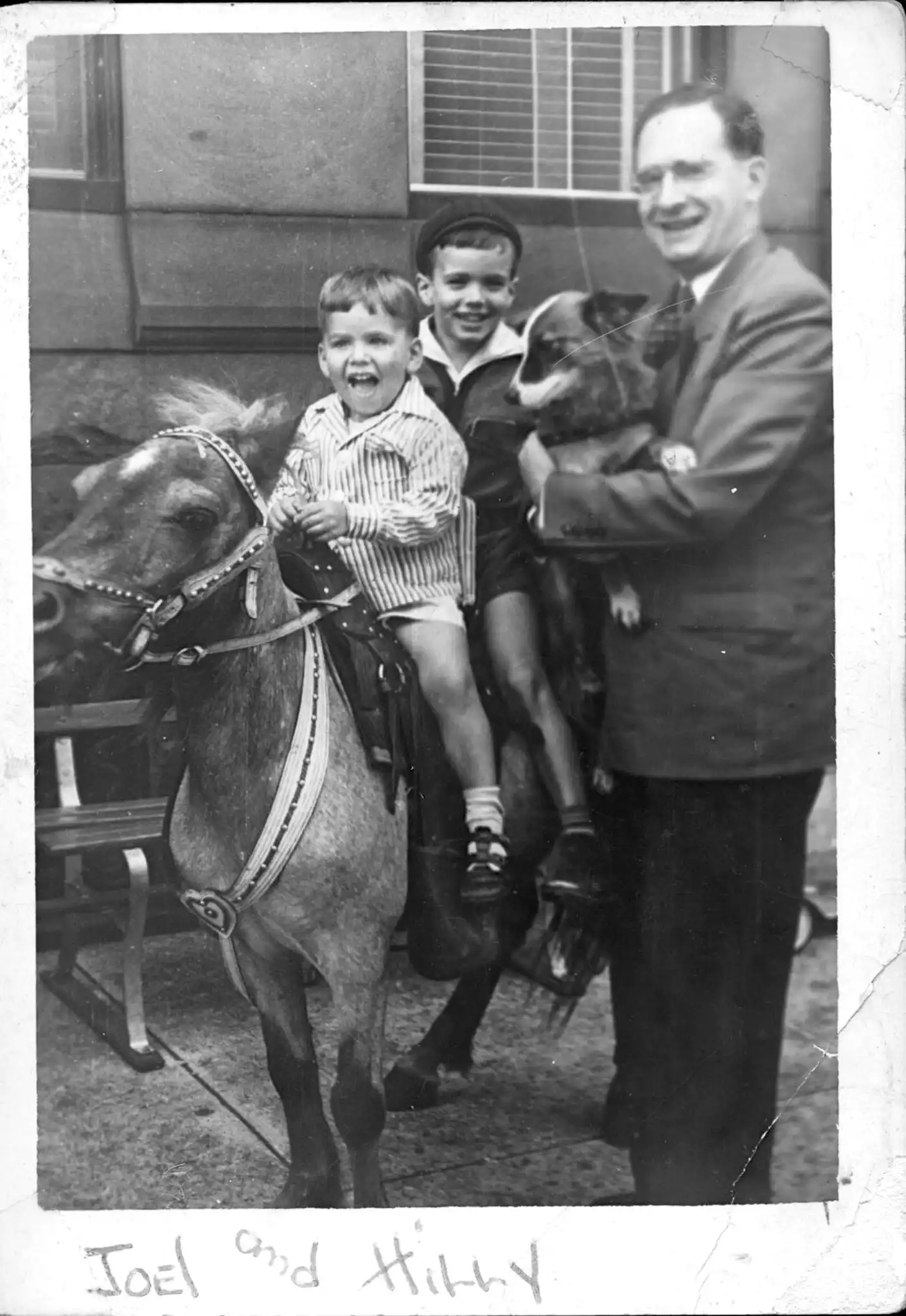
Around the age of five or six, while still living in the Strawberry Mansion section of Philadelphia, my father gifted me one of his summer hats he no longer chose to wear. Perhaps it was damaged or soiled or no longer in fashion. It was much like one of his regular winter smooth gray felt Fedoras with a brim and satin band but rather than felt this hat was a woven Panama, probably a Stetson, in a light, sand color. The fact that my father, otherwise not a particularly generous man, gifted me this adult possession surprised and amazed me and I wore it with immense pride. The gift came absent any special occasion and I strutted around the apartment thinking I was now somebody. I have always had a large skull but as a youngster it was surprising the Panama fit me at all, although it oftentimes decided not to cooperate and would slide forward over my eyes causing me momentary embarrassment…especially when my older brother caught sight of me playing bigshot.
I was free to be outside alone but I knew I had to stay relatively close to our home. One spring day I ventured out on the stoop of our three-story brownstone on Diamond Street wearing the hat and feeling special. None of my friends had their father’s Panama and I seemed to need to be somebody (Superman or Tom Mix), so the hat added prestige and a little height to my small frame. I wasn’t out there very long when two black kids, young teenagers I think, came walking up the block heading away from Fairmount park and toward (for me) the forbidden zone on the far side of Ridge Avenue, a place where my family never went, and as far I could tell a part of the city cloaked in mystery and danger. Standing close to our front door, I sensed no danger or ill-will as these boys approached and I even sat down on the sloping stone wall that flanked the steps. As they passed by me, the boy nearest me reached out and snatched the hat off my head in one sudden, lighting-quick gesture, much like the tongue of a frog snatching an insect in a fraction of a blink. I was startled at first. One minute I was sitting there, Panama on my head, feeling proud and happy and the next instant I was without my beloved hat, my badge of coming adulthood, a symbol of being special.
It now sat on the head of the stranger as he walked down the street, a jive cant to his step. He no doubt felt proud of his bloodless conquest. I ran inside and fell into my mother’s arms telling her through a face full of tears that somebody took my hat. Gone was a truly cherished possession, the gift that made me a little man, something once my father’s that had, up until a moment ago, belonged to me.
My father was always prejudiced against blacks — back then they were called Negroes or worse – and demeaningly referred to by my father and his cronies as schwartza. It was odd though that many of the clients in his law practice were black. I was told later in my life that he provided free service to the poor who had not the means to pay him. On this matter my mother was more enlightened and probably it was from her that I absorbed the sentiment that schwartza was an offensive term. Nevertheless, the incident of my Panama hat snatched from my skull in a gesture of presumed entitlement, struck me back then with a palpable, emotion-searing realization that there were blacks and there were whites. It was a notion that never registered before, but that violation of my person and my property altered my view of the world (at least in that moment).
If there were integrated neighborhoods anywhere in America in those days, they were few and very far between. I didn’t even recall blacks passing through our neighborhood going to or from the park (but of course they did), but that day changed it all for me. The sense of them and us became part of my understanding of the world in which I lived and even today as an old man, that instant brash robbery reverberates in me as an everlasting, iconic violation and an early marker of the fact that races were not melded back then, they were things apart, cultures separated, different peoples. Today I still harbor some tiny prejudice but I also chose to live in an integrated neighborhood and bring up my kids in an integrated neighborhood and happily live in one myself today. This ambiguous feeling of mine, or should I say, layered attitude toward blacks, that is loving most and fearing a few, leads me to remember how foolish the term racist society is. Because some whites fear blacks and others hate blacks does not make a racist society because this simplistic term does not account for all the whites who have loved, supported, honored, and fought for and married blacks, most notably, my mother although she never remarried.
Health
Around 1943, or sometime thereafter, my brother came down with an infection and was (I recall being told) among the first persons in the United States to be treated with the new wonder drug, penicillin. The family story goes that he would have died had he not received the drug. It is not surprising that this story was told in my family. My father was obsessed with germs. I recall that he would wash glasses with ammonia to prevent the user (me) from getting germs. This obsession perhaps derived from the fact that he grew up in the pre-antibiotic age when many people perished due to infections. My father lost his half-brother to syphilis. Alex Levinson’s syphilis was a subject not discussed and only shared with me as an adult. I recall being told he was found face down in the gutter but can’t recall where I had heard this.
A Sense of Wonder
About halfway between our row house on Diamond Street and the Park Theater at the end of the block lived a man who had fabricated something in his basement that I would today pay a hundred dollars to see once again. I don’t believe I was ever told who the man was or whatever happened to his extraordinary construction.
One day I was taken into his house and then down into the small low ceiling basement. He had constructed there a miniature Santa’s workshop, peopled by animated gnomes the size of dolls. I have no idea what force animated them but they all moved — tapping little hammers, appearing to saw pieces of wood and even applying paint to little fabrications…doing everything that one would expect of Santa’s helpers. I recall raw materials moved through the panorama and I was sure things were being fabricated for delivery to all my Christian friends.
The Lilliputian workshop was on a raised platform consisting of many levels and many of the gnomes’ heads almost touched the joists of the floor framing above. The place was busy with activity and there may have been music to accompany this chamber of industry. I was stunned that human hands could create such an extraordinary dreamlike panorama and to do have had this occur in a basement nearby in a not-very-well-to-do neighborhood was even more unexpected. As I think back on it, the event seemed more like a dream than real, but I am positively certain I went there, met the ingenious creator of this subterranean workplace and am certain I saw this unbelievable fabrication. The hours, the ingenuity, the dedication. I wonder whether it ever made it into the papers or on the radio or whether it remained a hidden phenomenon known only to a few adults and their incredulous children.
Camp Sonnikwa for Boys, 1946
Camp Sonnikwa for Boys
East Berne, NY
Aug. 7, 1946
My dear Mr. And Mrs. Levinson
It is with the greatest pleasure that I report to you on Joel’s progress at camp. He has acclimated himself very nicely to camp routine. He can very easily take charge of a group, due to his keen sense of responsibility. He is very reliable and can easily be trusted.
At the dinner table he has good table manners and eating habits. He eats what is put in front of him and eats more than what is given to him.
Joel is a good athlete and is well liked by the boys in the bunk. He adapts himself very easily to all situations and can fill in anywhere.
I feel sure that Joel is having and will continue to have a very pleasant summer.
Sincerely,
Ronnie Riefling
Fred Rosenberg
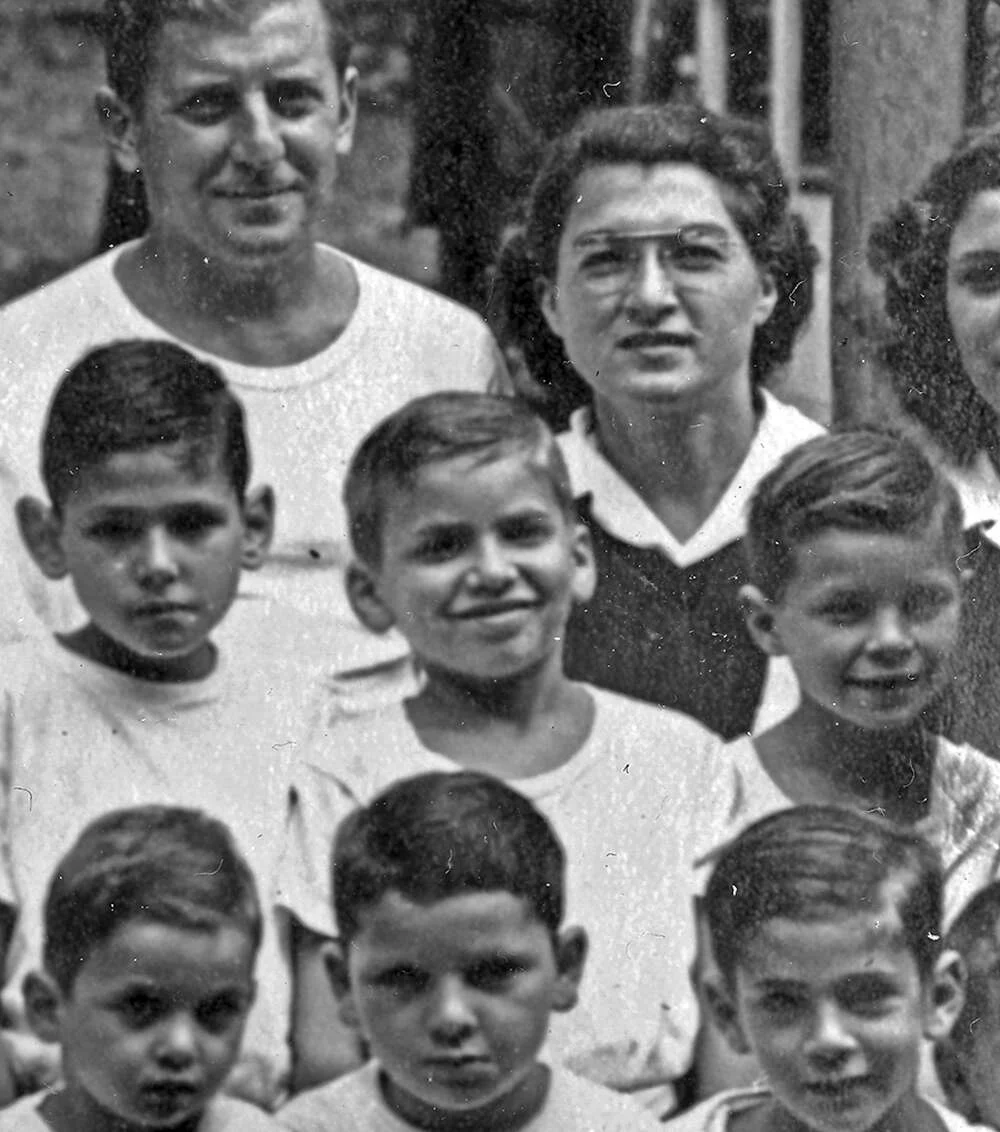
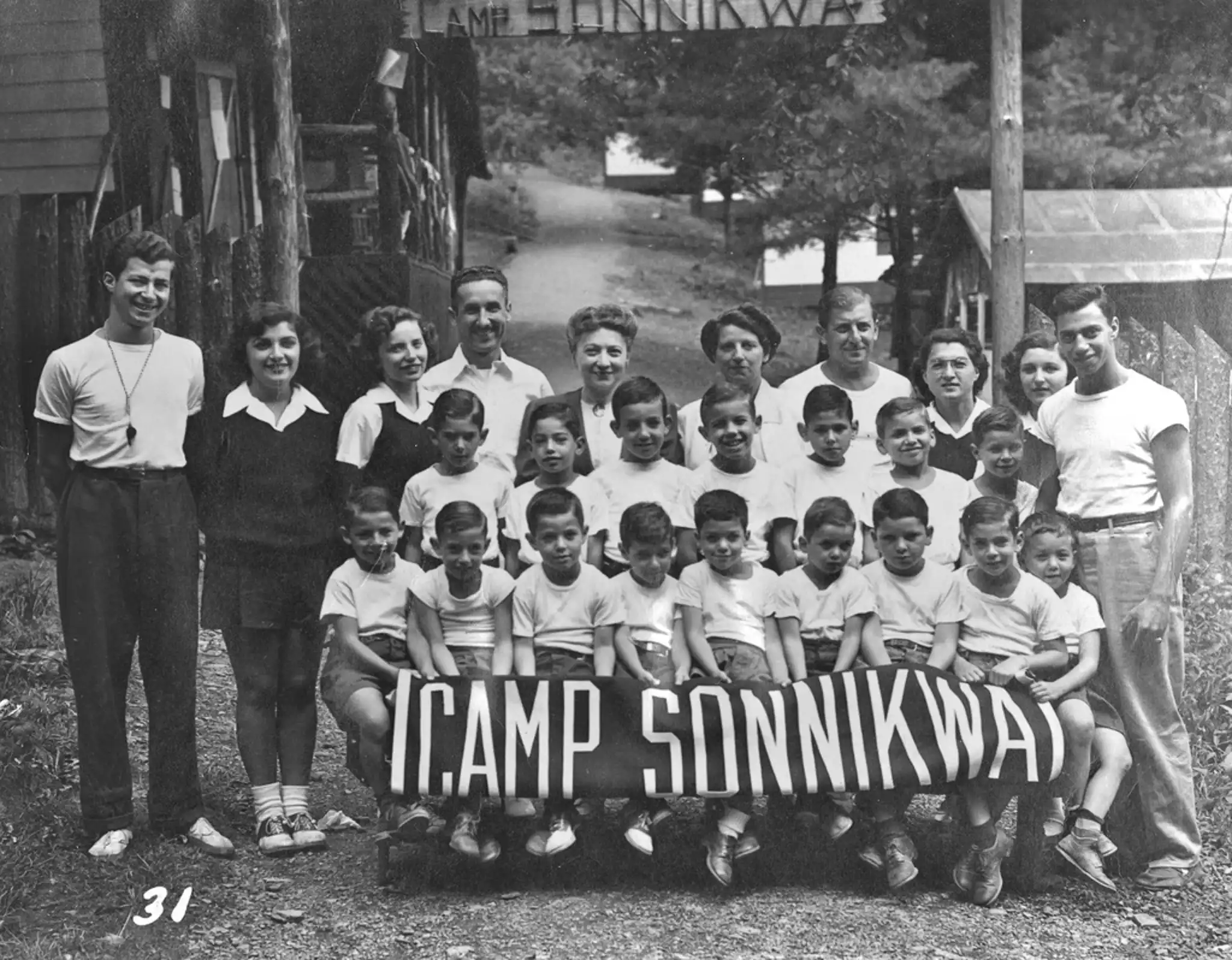
Jo-Jo the Iron Man: Born to Lead
As I look back on the past eighty-plus years of my life, it is obvious to those who have known me that I was born a leader. My purpose in stating this is not to brag or self-aggrandize but simply to acknowledge that leading…rather than following always came naturally to me.
My earliest memory of this trait is when I was about six years old and I formed a little club of kids; or it could have been that the kids naturally gravitated to me to “lead the way.” Photos of me from the era show my head cocked a bit and looking directly into the lens; I was always ready with an idea, or with a plan to move forward, or with an easy laugh.
I enjoyed a fertile imagination from the earliest age. I’m sure I was inspired by movies I saw at the Park Theater in the Strawberry Mansion section of Philadelphia, a hundred steps from our front door. Movies starring Superman, Tom Mix, The Lone Ranger and Tarzan filled me with images of men taking charge, leading the way, saving the world or coming to save a damsel in distress. During this period, I acquired the nick-name Joe-Joe the Iron Man; some close friends still call me Jo-Jo. If I had to guess, I would bet on my having come up with the name myself. This might have been the start of a lifelong predilection for naming things: groups, book titles, captions, themes, and titles for my photographs and short stories.
Even in my eighties, some people, old and young, still call me Jo-Jo.
Ring Finger
I hide my ring finger because the nail is a deformed embarrassment to me. It wasn’t always deformed with its sharp ridge that separates the plateau of the concave curved ‘flat’ area from the side canyon from which grows a hangnail that always needs to be clipped. Sometime before the age of eight, that finger got infected and our neighbor-doctor on Diamond Street bandaged it up in a hotdog roll of gauze and tape that caused me and my family some amusement. It seemed like a long time before the doctor removed the bandage but when he did, there was the putrid, nostril-penetrating smell of puss that I had never smelled before. My recollection is that my original nail unceremoniously fell off, limply revealing another nail and yet another nail growing under that second nail. The doctor cleaned up the foul smelling mess and re-bandaged my finger. When that bandage was removed, I was left with my embarrassment.
I learned to tuck that finger under the others or hide my left hand entirely in a manner that I worked to make not noticeable. But when someone caught sight of my embarrassment, they couldn’t take their eyes off of it, same as when I see someone else’s deformity. Deformities are like magnets that grip the vision of those nearby and don’t let go. Why is that? Humans stare at and maybe fear what is different. For a visualist like me, the sight of a deformity is irresistible. Missing fingers, stumps, odd-shaped or missing ears, weird eyes, twisted limbs and lips, mangled noses, tiny chins, forward sloping foreheads – all are visually magnetic prizes.
With new girlfriends in particular and with employees I am on guard to conceal my misshapen nail, which may be why I chose not to wear a wedding ring — but that is another story for later in this (auto)biography. Just imagine the sneaky maneuvers I have had to go to to make sure a lover never felt the sharp ridge and cutting edge of that surgical instrument I call my nail. What must they think to be caught up in the passion of the moment when suddenly the poor lass feels something cutting down the silky smooth skin of her back, or worse yet, inflicting an unexpected pain in that hidden groove where pleasure had been expected and where that groove is already responding with warmth and moisture.
I wonder whether, if I were not planning on being cremated whether indelible habit would cause me to curl out of view the end of my damaged finger so that for eternity my secret would forever be hidden.
WILDWOOD – A MIRACLE OF SURVIVAL
LIFE IS LIKE thin sheets of seawater sweeping up across the beach, then sliding back into the ocean. Each receding wave leaves behind a few gasping bubbles and a handful of sand crabs scurrying around in search of something not visible. For a moment, we see the damp beach, then it disappears behind another veiling reflection of sky and clouds. Here one moment, gone the next.
We still lived in Strawberry Mansion when World War II was winding down that year. My mother had taken my brother and me for a week’s vacation in Wildwood, a seaside resort roughly halfway between Atlantic City and Cape May. Mom had rented on the second floor of a beachfront cottage. As we got out of the cab, enormous raindrops, the size of sand dollars, suddenly fell from the sky and hit the concrete pavement with splats as loud as machine gunfire. We dashed to the steps and into the security of our apartment, which consisted primarily of a single room with windows on three sides that faced the ocean. Some closet-sized bedrooms faced west, back toward the bay, and to the state of New Jersey and beyond that to Philadelphia, which, just then, seemed a lifetime away. My father, Abe, was a private and inaccessible man. He remained in Philadelphia attending to his law practice and, I’ll presume, to the skirts that fluttered on the streets of Center City. I could imagine he was happy to have some time alone, away from the family.
Oh, do I wish my mother’s ashes could speak. Perhaps they could tell me why we were not swept out to sea during the 1944 hurricane that furiously pounded Wildwood, New Jersey. Somehow, miraculously, my mother, Lydia, my brother Hilly, and I survived while countless others perished. I think it was the first time I experienced my mother as a person separate from me— separate from my needs and wants, a woman vulnerable and afraid just like I was.
I wish I could ask her why we survived, why we weren’t sucked into the sea like all the others. What could she tell me of those terrifying hours? I want to go back to Wildwood and experience it all again. But this time with the assurance, of course, that the outcome would not be changed by some malevolent writer of fiction, invisible above the fury of those unforgettable, cyclonic clouds.
It was already late afternoon when the taxi returned us that day to our apartment. A taxi seemed an extravagant mode of transport, given what I presume my father’s income was back then. But perhaps news of a storm had already circulated, and people spent whatever was required to seek shelter as quickly as possible. As we got out of the cab we were assaulted by unusually hot and humid air. Enormous rain drops …..
The wind was starting to whip up, and the ocean looked troubled. Swells started far out near the horizon and rolled in like lines of tanks arriving for battle. The sun was eclipsed from view by clouds marauding across the sky. It was like a war-machine of nature had been sent to our shores from the real war that still raged on the far side of the Atlantic.
The stream of retreating bathers had cleared the beaches within minutes of the arrival of that odd and ferocious rain shower. The narrow street next to our house was now empty. Then the rain suddenly vanished, swept aside for the moment by buffeting winds. I noticed a car drive up alongside our house and park no more than thirty feet from the roughly five-foot-high sea wall that protected our house and what surrounded us. A thin man wearing a white dress shirt, black tie, and a lightweight black business jacket hopped out of his car with a bulky press camera swinging like a dead weight from one arm. He positioned himself with feet firmly planted on the macadam to take pictures of the angry sky and the wild ocean.
Waves repeatedly exploded in green-white fans as the sea smashed against the sea wall. He spun quickly as water splashed over him and swirled forcefully in treacherous pools around his legs, soaking his pants up to his belt. But he kept shooting, trying to protect his gear, slipping photographic plates from his jacket pocket into and out of the rear of the camera.
My mother opened one of the windows that formed a continuous band around this fragile summer room and screamed into the howling wind, imploring the man to leave. Even at five years of age, I was proud of her concern for the welfare of this total stranger. Still, I recall thinking she was a tad premature in expressing her concern. I can still hear the desperation in her voice. She kept desperately alerting him to the mounting danger that was frighteningly more visible from our elevated vantage point than from his. A massive plume of seawater suddenly shot up over the wall. The man jumped back into his black car, barely escaping a mountainous wave that rose from the sea and could have done him in.
We watched the ocean grow more violent as huge waves slammed into the sea wall and crashed thirty feet over our house. I think my brother and I would have been terrified if we understood the peril that was descending upon us.
I wish Mom’s ashes could speak to me today and tell me how heart-stopping scared we were just then. The house shook as the ocean’s mountainous waves relentlessly pummeled the house, driven by 90 miles an hour winds.
The owner of the house lived alone on the first floor. She came up the back steps to confer with my mother from time to time with a frightened look across her white face. Our landlady agreed to stand on a table periodically and bang on the ceiling to let us know she was still all right. We could hear her below us when there was a lull as she pushed furniture against the door that faced the ocean and what remained of the crumbling sea wall. Then the sea would surge again, crashing open the door and slam her and the furniture to the rear of the room in a grinding screech.
Outside of our water and sand-streaked windows, the ocean and the sky had fused into a ferocious cauldron of cyclonic energy, gray and furious, whirling and battering, and in a state of unspeakable fury.
I was five years old at the time, my brother seven, and my mother in her lovely thirties. Perhaps all of us were lulled into believing that the house would somehow protect us against the immeasurable fury of nature. That’s what a house is supposed to do, isn’t it; protect! Although the bungalow was anchored deep into the sand through wood pilings, with each onslaught of waves, the building shuddered and groaned. If Mom had been terrified, I can’t recall. Knowing her, she would have tried to conceal it from us even as she frantically bit her lower lip.
I found the green periscope-shaped flashlight I had stowed in my carry bag. I pressed the aluminum button to send flashing signals hoping someone would come and save us. I must have been terrified because, at some point, my mother said, Joel, look out the windows to the left. When you see that house go, then you can be scared. The words were not entirely out of her mouth when the house imploded and was sucked down into the sea’s raging waves. So loud were the howling winds swirling around us, we could not hear the explosion or implosion and certainly could not the cries from anyone trapped within.
Come back, Mom. Tell me what happened next. Were we all crying on the floor, or praying? Certainly not praying! Mom’s father loved Bertrand Russell and subscribed to Russell’s brand of atheism, as did my mother, as I do now. Mom was an atheist until her dying day’s fifty-some years later when she decided to hedge her bets and accept that there might be a god out there after all. If there had been a god out there in that hurricane of 1944, he must have abandoned his watch. Or the nature that he was supposed to have created momentarily over-ruled him. I would love to know what we were all thinking, and feeling, or saying, or fearing to say in those moments when our lives were hanging in a terrifyingly precarious balance.
We must have slept for a while (I can’t imagine how) because my next memory is that of a sunny sky and a peaceful ocean. It was if the hours of dark and untamable madness had been but a dream.
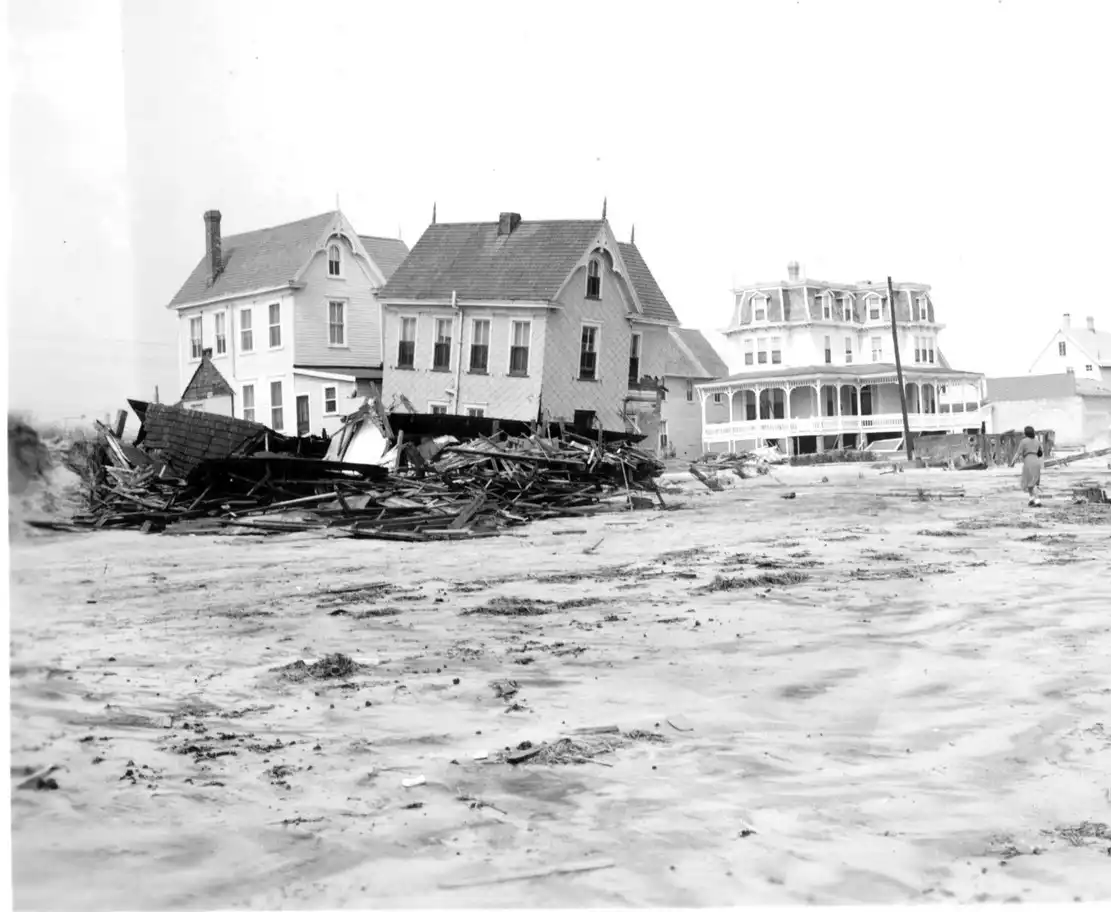
Up and down the beach, we could see only a handful of isolated houses, porches torn off, windows blown out, some leaning sideways. Before the storm, there had been an unbroken line of houses curving along the coast to the north and to the south. It was a scene of such total devastation that it has been impossible for me to erase the view from my memory. Sun, tranquility, and utter destruction, like a psychopath’s misprinted picture postcard. Did my brother and I realize that hundreds of lives were washed into the sea that night, along with countless houses? It didn’t register then, at least for me; it surely does now. To this day, I still grow fearful when the wind howls.
Our cottage now stood in the middle of the sea, as if this were a perfectly normal circumstance, and we should go about enjoying the day as if we were on a fishing boat. Our landlady, who had come upstairs with us sometime during the night, was inconsolable.
Eventually, two men in yellow raingear rowed a large lifeguard boat up alongside the house. One man steadied the heaving boat as the other man struggled to muscle a ladder in our direction. The four of us huddled in fear and hope on a small, cantilevered second-story stair landing where yesterday’s outside stairs had once been affixed.
We were all afraid to descend the swaying, sliding ladder into the arms of a stranger, no matter how strong and tan the guy looked. First, they carried me down, then Hilly. Then he went up for my mother, her sundress fluttering in the breeze, that irrepressibly flirtatious smile beaming on her face, but her heart no doubt skipping wildly with pent-up anxiety.
Our landlady was now alone on the balcony. She wailed in terror and relief, covering her face in embarrassment, in grief, and in unfathomable sorrow. Initially, she refused to let her chubby body be picked up and carried down, away from everything that had been the center of her life for decades.
Hilly remembers they rowed us to an isolated stretch of visible road. From there, we were supposed to walk to a bus terminal or a train station through shallow pools of seawater plus who knows what form of debris, maybe even body parts. We saw a kitchen tabletop that amazingly still held a plate with a slice of pizza seemingly glued to it.
Far in the distance, we saw a tiny dot appearing to move toward us. The dot loomed larger, and then we realized it was a man racing toward us along the half-submerged roadway. He sprinted through pools of seawater, dodging pieces of building floating like rafts.
When we finally realized who it was in his white linen suit and straw hat, wearing his fancy lawyer shoes, we raced toward him. His face was white, nose a bit red, tears filling his weary small eyes. He had boarded the first train he could get with no assurance we were still alive. Knowing my father, he probably had already steeled himself for what he must have presumed was the near-certainty that we had been dragged out to sea. Having feared the worst and wondering whether he was still dreaming, Dad must have thanked God for the miracle he was now hugging with all his might. Three-quarters of a century later, that hurricane seems dream-like for sure, but both a dream and a miracle forever seared indelibly into my memory.
Postscript:
I had a recurring dream coming to me weekly over several weeks …but this was years ago. I am on the floor of the ocean-facing room in Wildwood sending weak signals against the wall with my green flashlight. It is sunny. My mother is at the window in her red hat, silver hair blowing in the ocean breeze, looking through John’s old binoculars. She sees a Spanish galleon on the horizon and turns to me with a smile on her face. I understand through the tears in her eyes that she craves to go on another voyage around the world. When I stand, she disappears. I walk to the window and look out on sheets of seawater sweeping across the beach, then sliding back into the ocean. They leave behind a few gasping bubbles and a handful of sand crabs scurrying around in search of something not visible. I see the beach changing color from one moment to the next, and then as a new wave washes up, the sand disappears beneath a reflection of sky and clouds. Here one moment, gone the next.