
The Avenue of American History Project
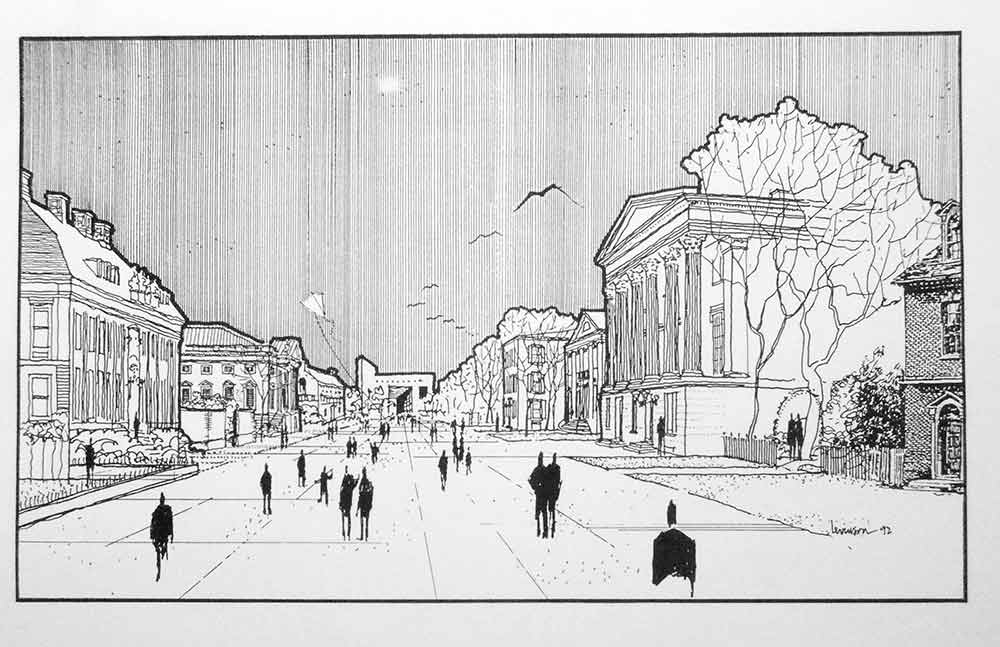
An early rendering of the proposed Avenue of American History
The Avenue of American History Project is a revitalized endeavor intended to create an Avenue of American History in Philadelphia in 2026 as the focal event for the 250th commemoration of the country’s founding. The Avenue of American History Project is described below in a Concept Statement.
Our Group also explored the feasibility of creating Avenues of History in other countries and perhaps linking them through the internet. In 1996, I assembled an international team of consultants and advisors including the Museum of London to submit a proposal to the Millennium Commission in Great Britain to create an Avenue of British History. The Group was encouraged when it received a Phase 1 approval from the Millennium Commission. Ultimately, Millennium Commission funds to create a major tourist attraction went to the Millennium Dome project, but the appeal, interest in, and feasibility of creating an Avenue of History was formally validated.
Additional materials will be added to this site through the summer as a team of volunteers work to expand a proposal to create an Avenue of American History for the country’s Sestercentennial in 2026.
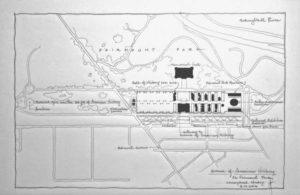
This is the current conceptual site plan for our proposed site in Fairmount Park, Philadelphia.
This image is under construction; although the original is hand-drawn, we are currently endeavoring to make this reproduction sharper and as readable as the original.
AVENUE OF AMERICAN HISTORY
CONCEPT STATEMENT 2016
OBJECTIVES:
- Our central goal is to create an Avenue of American History (AAH) that will open to the public in 2026, two hundred and fifty years after the birth of the Nation.
- The general location that we are currently investigating is Fairmount Park in Philadelphia. The specific site we are exploring is a small portion of the tract of land that was used for the Centennial Exposition of 1876 that commemorated the birth of the Nation one hundred years earlier.
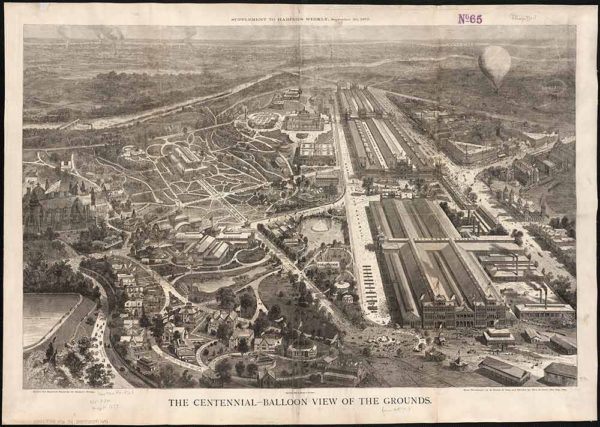
- A building called Memorial Hall still stands on the site and our desire is to use that building as the gateway to the Avenue of American History.
- The Avenue of American History will be a not-for-profit institution funded by a variety of sources.
- Our Development Group has a well-developed funding strategy and a project implementation strategy supported by various pro-formas that would need to be updated for the current initative.
- On land nearby but outside of Fairmount Park, for-profit, theme- appropriate, facilities could be constructed. For permission from the AAH Corporation to create such facilities to serve the needs of visitors to the Avenue of American History, a portion of the profits from those for-profit ventures would go to support the Philadelphia public school system, which historically has been cash-starved to the detriment of the City and the Nation.
WHAT IS THE AVENUE OF AMERICAN HISTORY?
- The Avenue of American History is a radically new vision of an American History museum. The project calls for each generation to write its own history and for the collection of histories to be permanently recorded in a chain of individual buildings, each representing a quarter century of our nation’s history.
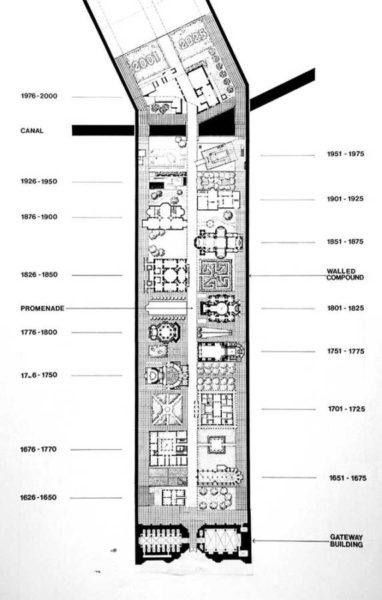
- Every twenty-five years a new Hall of History is added to the end of the chain, thereby creating an Avenue of living accounts of American life created by those who lived it. Choosing what to include, celebrate, hide or ignore will be the central challenge in this incremental museum as each generation, starting with our own, determines and presents its own legacy.
- The Avenue will consist of three integrated and interdependent areas. Area One embodies the Avenue’s central reason for being, which is starting a tradition of creating generational legacies. The tradition will start with our generation writing its history for the period 2001-2025 and preserving it in a Hall of History that captures the zeitgeist of the preceding quarter century.
- What might be called our Hall of History will have exhibits of recent contemporary culture that will reflect the findings of a National Conversation. The period covered would be January 1, 2001 through December 31, 2025. We expect that the Conversation to determine our legacy would be a widespread adventure involving students, historians, and Americans from all walks of life and from all disciplines and faiths. Presumably, the tragedy of 911 and the election of the first African- American president will be key developments important to document. The design of our Hall of History (and all future Halls) will be the result of national design competitions. For our Hall of History, the design competition would be held in 2022. The building design will take a year (2023) and construction another year (2024). Exhibits will be installed in 2025. Site design and installation of infrastructure for the overall complex would occur starting around 2020.
- Area two on the Avenue of American History is an open landscaped zone immediately adjacent to our Hall of History and set aside for future generations to build their Halls. Each reserved building plot (8) for the next two-hundred years will be marked out with the time period identified in contrasting plant materials. In this respect, the Avenue is open-ended, both physically and conceptually, its value increasing as our society continues to evolve.
- The third area is the section of the Avenue of American History that provides a way of immediately introducing historical perspective into the complex. The idea is to build several Halls of History for the quarter- century periods before 2001. These structures and the exhibits they contain are necessarily historical suppositions and will be so identified. How many retrospective halls of history might be built will largely depend on funding.
- The retrospective section will contain our generation’s best guess as to what each past generation’s view was of the most important events, personalities, social changes, cultural products and scientific advances that occurred at that time.
- To create yet a broader perspective, all new Halls of History will contain two special rooms. In one room there will be a vision of the world one hundred years in the future presented by the generation then living. In the other room, subsequent generations will be invited to appraise the history written by the people who actually experienced it. These rooms should foster an on-going dialogue about the past, presented with the benefit of hindsight and changing social values.
- Another dimension that should be explored is the idea of creating a virtual tour of the Avenue of American History, with internet access to the Halls of History provided to everyone in the US and around the world. With a digital version of the Avenue, there is no limit to the depth that a visitor could investigate regarding any aspect of history within each Hall.
- We are currently developing a site plan for the Avenue on a prospective site in Fairmount Park in Philadelphia.
THE CHALLENGE – WHOSE VOICE?
- Who will decide what messages and what objects are preserved in the Halls of History? Will the rich speak or the poor? The majority or the minority? The powerful or the weak? The idealists or realists? The Northerners or Southerners? Those on the east coast, the west coast, or the plains states? Conservatives or Liberals; Democrats, Republicans or Independents. At different times through history, different segments of society have had a stronger voice than others. To some degree, what our society today is all about is its sensitivity to finding a voice that includes us all.
- These questions about “Whose Voice” are at the very heart of the project; this question will represent the project’s ultimate significance and will provide its perennial challenge.
- However, it should be appreciated that what will be presented in all the Halls of History, by the nature of this project and by human nature, will to varying degrees be incomplete and biased images whose message will very much be dictated by the value systems operable in each quarter century. Different from what one would find in an ordinary museum, the main exhibit spaces in this project’s retrospective Halls of History will not represent what some of our best historians, looking back, might choose to say about what happened but rather what our best historians believe the people of the time would have chosen to say, given their time-anchored view of events.
- Of paramount importance in understanding the special nature of this project is that no generation’s presentation will go unchallenged. There will always be an invitation for future generations to present another point of view in the special spaces provided in all the Halls of History. This feature is what makes the Avenue of American History distinctive and value building.
SIGNIFICANCE AND CHARACTER OF THE CONCEPT:
- The Avenue of American History should be regarded as a new and compelling educational tool in which the uniform time periods and the ongoing dialogue between past, present, and future will draw in youngsters and enable them to see their place and their potential in the flow of events we call history. We also see the Avenue as a place of entertainment, as a visually stimulating, attractive, and emotionally stirring place to visit. We anticipate the project will be a dramatic and integral part of Philadelphia’s growing hospitality-based economy, a tourist attraction that will significantly boost the City’s and the region’s reputation nationally and internationally. We believe the local economy will be improved by the jobs created in designing, constructing and operating the core facility and by all the possible secondary development projects that may be attracted to the site environs.
- We also envision the project illuminating the very process of recording history. For history in the eyes of many is no longer viewed as a body of immutable facts, free of bias, but as an on-going activity that is subject to both deliberate and inadvertent distortions because it is, in the end, a self- referential endeavor. History, as a narrative created after the fact, rather than the body of source events themselves, is in its simplest terms both a story about the past and the act of telling the story. It is therefore always subject to revision. The Avenue will help reveal history as a constantly changing reflection of ourselves mirrored in the reflective surface of our own humanity.
- Our AAH Development Group believes the AVENUE OF AMERICAN HISTORY will encourage the self-evaluation of a people. In turn, each person may be inclined to measure his or her role in society. Our differences in this melting pot of immigrants will be poignantly illustrated; so too will the accommodations that must be worked out between those of differing views. Hopefully a greater sense of tolerance for the dissimilar views and lifestyles of others will be fostered as a result of seeing that some of the battles have been won in the on-going effort to allow our differences to flow as adjacent currents in a broad and common mainstream.
- Youngsters walking with their parents on the AVENUE OF AMERICAN HISTORY may be inclined to ask: “What ideas and things will we put in our Hall of History? What will we leave behind?”
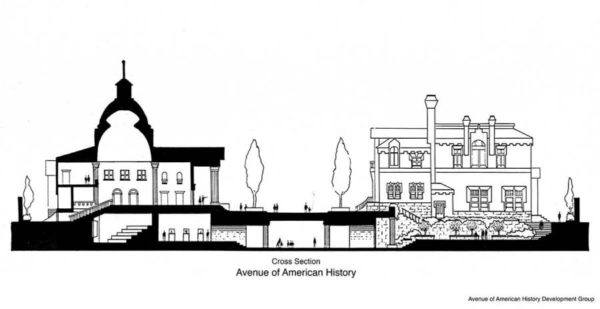
This cross section through the Avenue shows an all-weather concourse level below the open-air promenade.
The concourse level opens to sunken gardens that bring natural light to the lower level.
VISION STATEMENT
Imagine that sometime between 1650 and 1675, a group of settlers in Pennsylvania decided to erect a small building to commemorate their experience. The group decided what objects and statements should be preserved that would speak to future generations of their unique and trying circumstances in creating a new society in a new world. And they built what they called a Hall of History.
Imagine that twenty-five years later, say in 1700, after having visited and enjoyed the original Hall, the descendants of the first group decided to create their own Hall of History across from the original Hall. The new Hall’s exhibits illuminated various political developments, which occurred since the first building was constructed and included significant cultural developments. Participants from a wider geographical area had now become involved and various points of view were expressed.
Imagine another twenty-five years passed and the year was now 1725. This next generation also felt the need to speak. Their Hall of History was somewhat larger and more refined than the earlier two. Its exhibits reflected not only political, religious, and social changes but also scientific, commercial and educational developments. Like the preceding groups, this generation also faced the challenge of deciding what to say, what to boast about or to conceal, and what objects to exhibit that might capture the spirit of their times.
Imagine that as a result of these first three buildings, a tradition was firmly established of adding to this chain of historic legacies every twenty-five years and imagine further that as the centuries passed, the tradition was never broken. Had this happened, a youngster from anywhere in the United States could today walk down an AVENUE OF AMERICAN HISTORY and see his or her own society unfold, and listen to the “voices” of the past speak out about the changes that made the U.S. what it is today. What we have asked you to imagine never occurred. But why not start the tradition today?
Imagine that it is December 24, 2014 (200 years after the signing of the Treaty of Ghent) and our own generation opens a building commemorating the period 1985-2010. A youngster who walks down our Avenue of American History in the year 2014 could return in 2035 to take the same stroll with his or her children, and return in 2064 with children and grandchildren. Two more new buildings would have been added in that time which would reflect subsequent generational views; new challenges, successes, failures, tragedies and joys. Every twenty five years the eyes and ears of the nation would turn to Philadelphia to participate in a National Dialogue to determine what should be said in the next hall of history and to see what exciting new structure will be built to capture the spirit of the times.
To create yet a broader perspective, each Hall of History will contain two special rooms, one in which a vision of the world one hundred years in the future is presented by the generation that creates each hall, and another room in which subsequent generations are invited to appraise the history “written” by the people who actually experienced it. These rooms should foster a continuing dialogue about the past presented with the benefit of hindsight and changing social values.
This is our vision of an AVENUE OF AMERICAN HISTORY. This is a vision that we believe will translate into a vital tool of our society, a unique educational experience, and an integral, dramatic, and invigorating addition to the cultural infrastructure of Philadelphia. It holds the promise of being a compelling international tourist attraction of the highest order.